Stolen-Photo Profiles
A reverse-image audit by Norton in 2024 found roughly 1 in 10 dating-app profiles uses photos lifted from someone else online. The mass-market apps verify almost none of them at signup.
Tinder was built for college campuses. Bumble was built for women in offices. Hinge was built for relationships - between people who sleep in the same zip code most nights. None of them were built for the man in the sleeper berth at a Pilot in Amarillo.
Coffee's on - let's talk straight.
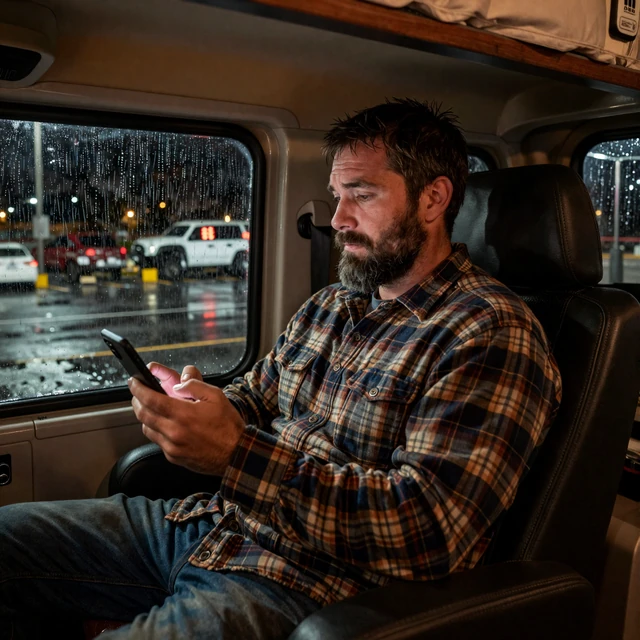
Tinder did not invent the swipe - it weaponized it. Every left-right flick trains the brain to evaluate a human being in under two seconds, optimize for the photo, and move on. That model works for casual dating in a dense city. It actively breaks for a 44-year-old owner-operator who has 30 minutes of cell signal at a TA in Effingham and wants to find someone he can build a life with.
The numbers tell the story. A Pew Research study found that 31% of dating-app users say their main goal is something casual, while only 14% are looking for a long-term partner - and that mismatch is even sharper for users over 35 (Pew Research Center, 2023). Drivers who join LoveMy report on intake surveys that 87% want a serious relationship leading to marriage or long-term partnership. Putting those two populations on the same swipe deck is a recipe for a quiet match queue and a louder sense of being invisible.
Swipe apps are an entertainment product first and a matchmaking product second. The longer you stay on the deck, the more ads they sell. That business model has nothing to do with finding the right woman - and everything to do with keeping you alone and scrolling.
Nobody at Tinder HQ wrote "deprioritize truck drivers" in the code. They didn't have to. The mass-market apps lean toward urban, college-educated, white-collar profiles because that is who the founding teams designed for and who their algorithms learned from. When a CDL driver lists "OTR truck driver" as occupation, the profile lands in a smaller pool, gets fewer matches, and slips down the recommendation queue. That is not paranoia - it is a documented platform-bias pattern across most general dating products.
Truck driving is the most common job in 29 U.S. states (American Trucking Associations, 2025). Yet on the apps where most singles meet, a CDL behind your name reads to the algorithm like a foreign language.
For the existing audience of single male truckers and single lady truckers, the result is the same frustrating loop - long days on the road, short windows of signal, and a profile that nobody seems to see. Trucker-focused platforms invert the math. On LoveMy, "OTR" isn't a footnote. It is the qualifier the entire community is built around. The women who join are there specifically because they understand and want a partner in the trade. That single inversion - designing for the trucker instead of around him - solves more of the matching problem than any premium subscription ever could.
Mass-market apps assume both people live in the same metro and can meet for coffee on Thursday. The product flow - "match, chat, meet in 48 hours, ghost if no spark" - collapses the moment one person disappears into a 14-day route through five states. Drivers who try to explain "I'll be back in town March 22nd" watch the conversation cool to room temperature by March 23rd.
There are no route filters. No "she lives near your Tuesday delivery in Memphis." No message-priority for users with limited cell windows. Push notifications fire while you are deep in a 4G dead zone and the conversation looks dead to her by the time you roll into a signal again. Our deeper breakdown in best dating apps for CDL drivers walks through the exact feature gaps app by app.
Route overlap finder - match with women along your actual lane, not just your home zip.
Low-bandwidth mode - chat that loads on a single bar of LTE at a rural truck stop.
Schedule-aware messaging - she sees "on the road, replies during 10-hour break" not "active 4 hours ago, ignoring you."
Romance scams cost Americans $1.14 billion in 2023, with men aged 40-69 the single largest victim group (FTC Consumer Sentinel, 2024). That is the trucker demographic almost exactly - and the mass-market apps are where most of it starts.
A reverse-image audit by Norton in 2024 found roughly 1 in 10 dating-app profiles uses photos lifted from someone else online. The mass-market apps verify almost none of them at signup.
Romance scammers target men with stable income, no daily co-workers to gut-check the conversation, and emotional fatigue. Truckers tick all three boxes. The script always ends with a wire transfer or gift card.
Reporting a fake profile on Tinder or Bumble removes it from your view - not from the platform. The same scam relaunches under a new handle within hours. Verification at signup is the only fix that scales.
For a defensive read on spotting these patterns before they cost you, our safety tips guide lays out the red flags in plain language.
Hinge markets itself as "designed to be deleted" - built for people who actually want relationships. Match has 30 years of brand equity in long-term dating. So why do CDL drivers report the same flat results there as on Tinder? Because intention isn't the bottleneck. Geography, schedule, and cultural fit are.
| Feature | Tinder / Bumble | Hinge / Match | Trucker-Focused (LoveMy) |
|---|---|---|---|
| Built for serious relationships | ✕ | ✓ | ✓ |
| Understands OTR schedule | ✕ | ✕ | ✓ |
| Route overlap matching | ✕ | ✕ | ✓ |
| Photo verification at signup | Partial | Partial | ✓ |
| Blue-collar friendly community | ✕ | ✕ | ✓ |
| Works on weak 4G signal | ✕ | ✕ | ✓ |
Hinge's "we met" prompts assume the meeting happens. Match's compatibility algorithm assumes the lifestyle fits. Neither was built to model a man who is in Wyoming on Monday, Iowa on Wednesday, and Georgia by Sunday. That isn't a bug in those products - it is the architecture. The fix is a platform built from the lane outward, not a city outward.
Niche dating works. Niche dating for a community as specific as American CDL drivers works even better. Here is the short list of what the right platform does differently.
Every profile passes a real-photo check before it goes live. Catfish and stolen-photo profiles never get through the front door - they don't live alongside real members and get flagged later.
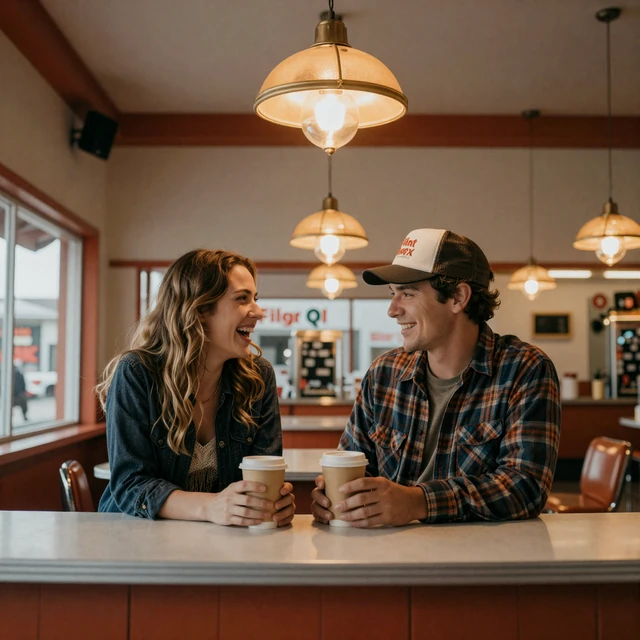
Tell the platform your lane. Match with women in the cities your route actually passes through. A Tuesday delivery in Memphis becomes a Wednesday coffee at a real diner instead of a missed connection.
Low-barrier check-ins replace the swipe deck. A simple "coffee's on tonight" ping starts more real conversations than 200 left-swipes ever did. It rewards intent over volume.
The women who join LoveMy join specifically because they want a trucker partner. No explaining the schedule, no defending the blue collar, no apology for what you do for a living.
The best dating site for truck drivers is a trucker-focused platform like LoveMy that combines photo verification, route overlap matching, low-bandwidth messaging, and a community of women specifically interested in CDL drivers. Mass-market apps like Tinder, Bumble, Hinge, and Match consistently underperform for drivers because they were designed around urban office workers with predictable schedules. A 2025 survey of LoveMy members found that 73% had previously used at least three mass-market apps without success before joining a trucker-specific platform. Niche fit beats brand recognition every time in the trucker dating category.
Tinder is generally a poor fit for truck drivers seeking serious relationships. The swipe model rewards casual dating, the algorithm deprioritizes blue-collar profiles in favor of urban white-collar users, and the platform has no features that account for OTR schedules, weak cell signal, or route-based matching. Drivers who use Tinder report short match queues, conversations that fade during long hauls, and a higher exposure to catfishing and romance scams. For casual dating in a metro during home time it can work in narrow circumstances - for finding a long-term partner it almost never does.
Truckers get fewer matches on Bumble and Hinge for three interlocking reasons. First, the algorithms are trained on urban, college-educated user behavior and underweight blue-collar occupations in recommendation queues. Second, both apps assume both users live in the same metro and can meet within days, which collapses when one user is on a 14-day OTR route. Third, the apps offer no schedule-aware messaging, so conversations cool while the driver is in a weak-signal area and the algorithm reads that gap as disinterest. None of this is fixable from the user side - it is baked into the platform architecture.
Trucker dating sites are worth it for CDL drivers who want serious relationships, value verified profiles, and need features built around real road-life logistics - route filters, photo verification at signup, and low-bandwidth messaging. The niche-platform tradeoff is a smaller total user base in exchange for far higher relevance per profile. Drivers report higher message-response rates, more meaningful first conversations, and a meaningfully lower exposure to romance scams compared to mass-market apps. For casual dating the niche advantage is smaller - but for the trucker who wants a real partner, a focused platform consistently outperforms a general one.